


In today’s fast and competitive business world, B2B market research tools is an essential step for any business trying to be ahead of the curve.
Whether you are working for a small startup or a large corporation, understanding your market, customers, and competitors is vital to ensure growth and success.
For B2B companies, market research becomes even more critical, as the dynamics of B2B marketing are quite different from the B2C product’s nature.
Here we will explore the world of B2B market research tools, as there are different types of these tools and will try to find the reasons for their importance.
This content is aimed at B2B businesses in the U.S., helping them discover the tools they can apply in their market research strategy and become more competitive.
Importance of B2B Market Research
Market research in the B2B field helps businesses make decisions and take further action based on data rather than assumptions or gut feelings.
It does not matter whether you are introducing a new product line or trying to understand the needs of your market.
Market research tools provide you with data that you can analyze and make educated decisions for your B2B business.
Here are the reasons why B2B market research is important:
- Identifying Business Opportunities: the market research helps B2B companies use them as a “radar” to discover new trends, see what customers need, and discover new businesses that they can develop.
- Understanding Competitors: the B2B research lets companies see what other businesses are doing. This knowledge is crucial as you will be able to be one step ahead of the competitors in the field. You will learn what is working for them, and you can try to leverage that.
- Enhancing Customer Satisfaction: Market research involves collecting data from your clients as well. You can use this data to work on the existing products or to develop new products or services to meet the customers’ demands.
- Making Strategic Decisions: with the data accumulated from the market’s research, you will see the market’s clear picture and be able to make meaningful decisions regarding product creation and adjustment, marketing, and sales strategies.
- Resource Efficiency: with B2B market research tools, you can see if your ideas or campaigns would work before putting a lot of resources in. Instead of guessing or using random strategies, you can use the data.
Types of B2B Market Research Tools
Let us start with the general types of B2B market research tools before moving to specifics. There are two general types:
- Quantitative Research Tools: Such tools focus on numerical data such as surveys and questionnaires. They provide measurable results, such as market size, growth patterns, and customer preference patterns. Common examples are survey tools, data analytics, and software providing business with lead generation techniques.
- Qualitative Research Tools: They provide deep insight into the world of customer opinions, attitudes, and motivation. Examples include guides on conducting interviews, tools to manage and organize focus groups, and tools to track the tone of consumer conversation. The results are often not measurable and rather subjective. Still, this data helps businesses understand why customers make purchases.
Top B2B Market Research Tools
SurveyMonkey
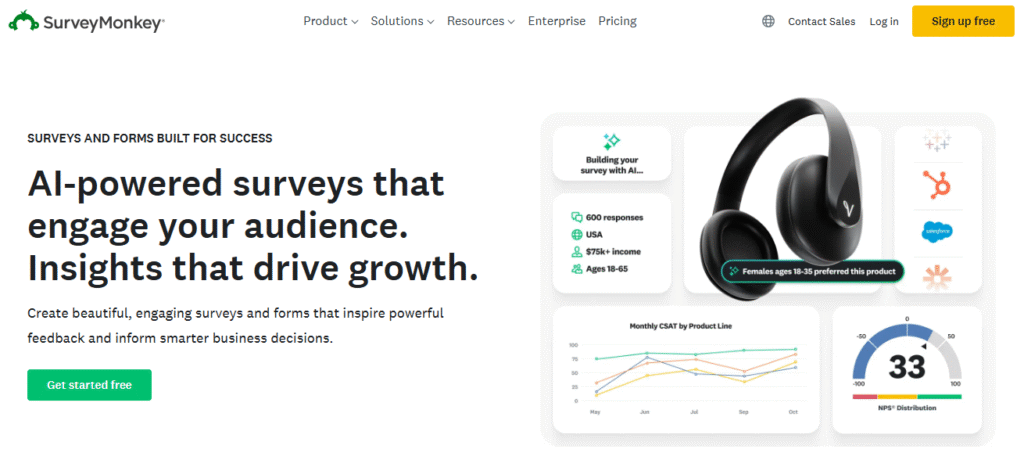
This tool enables companies to create tailored surveys and offers real-time response analysis.
SurveyMonkey is perfect for B2B companies that want to collect real-time quantitative feedback from customers, employees, or professionals in the field.
Key features:
- Survey design using the drag-and-drop interface.
- Survey data analysis and reporting.
- Survey B2B customizable template.
- Salesforce and HubSpot integration.
Best for:
B2B companies looking to collect structured feedback, insights on market demand, and measure customer satisfaction will find SurveyMonkey immensely useful.
SurveyMonkey is especially useful in providing feedback surveys on proposed products, measuring customer loyalty, and competitor assessments.
Qualtrics
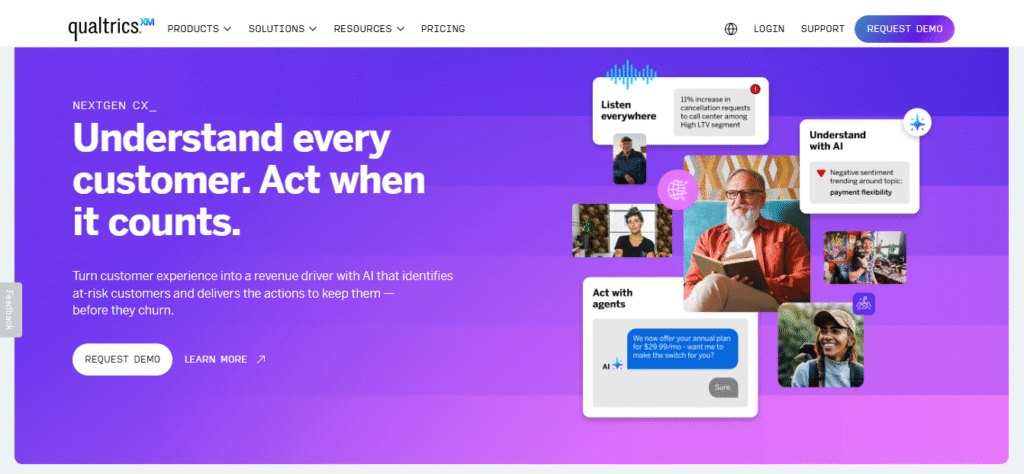
Qualtrics is an advanced qualitative and quantitative market research tool.
It is known for providing in-depth analytics and insights on customer experience, market trends, and brand value.
Key features:
- Surveys through email, mobile, and social platforms.
- Statistical analysis of data.
- Report customization for data-driven strategies.
- Real-time customer experience and market insights.
Best For:
Qualtrics works best with B2B businesses that have complicated and intricate research needs to be fulfilled.
If deep market segmentation is to be performed, brand health is to be evaluated, and customer journeys analyzed, Qualtrics will cater to needs by providing detailed data and workable insights.
Statista
Statista provides a snapshot of what a potential market research analytics system would look like for statistical data.
It provides a comprehensive market and consumer data for B2B companies.
Compiling statistics data from over 22,500 sources, Statista provides comprehensive and analytical data across finance, technology, and manufacturing industries, to name a few.
Key Features:
- More than 1 million statistics and documents for various B2B industries.
- Statistics on market performance and consumption, and perceptive analyses on competitive landscape.
- Industry-specific journals and insights covering performance and analytics over a set period.
- Customized research services to provide higher quality outputs to businesses with distinct data requirements.
Best For:
Statista helps derive relevant research statistics to guide B2B market research by providing comprehensive and current research metrics.
It helps drive research focused on industry standard evaluation, market trend identification, and competitor analysis.
SEMrush
Introduced as a SEO optimization tool, SEMrush provides an array of market and B2B research analytics tools.
Competitors, digital marketing efforts, and keyword identification are the primary research focused on SEMrush. Competitors digital marketing mechanisms, paid and organic search, and industry structure and performance data are some tools provided by SEMrush.
Key Features:
- Competitor analysis for both paid and organic searches.
- Thorough keyword research and market positioning.
- SEO performance site audit tools.
- Social media tracking and analysis.
Best For:
Competitive sector B2B companies benefit greatly from SEMrush.
For businesses looking to gain insights into digital marketing, identify key industry keywords, and analyze online competitor strategies. It is the best tool available.
BuzzSumo
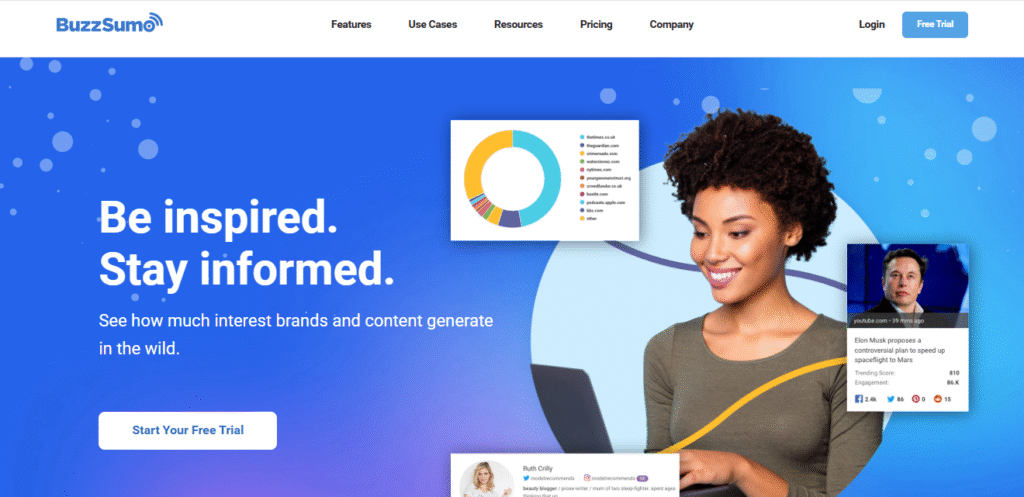
BuzzSumo is a content research tool that enables B2B companies to monitor trending topics, spot key influencers, and evaluate the content strategies of their competition.
It is an excellent tool for uncovering the content that speaks to your audience and identifying content gaps.
Key Features:
- Content discovery by search queries, keywords, and topics.
- Social media activity tracking and performance analysis.
- Industry influencers and advocates identification.
- Competitor content evaluation and benchmarking.
Best For:
B2B content-driven businesses that need to monitor trends closely will find BuzzSumo very valuable.
It is also valuable for observing competitive content strategies.
Additionally, they will find it invaluable to identify new content ideas.
LinkedIn Insights
LinkedIn is the chief platform for professionals, and, as such, offers powerful market research options through its Insights feature.
Because of the extensive resources LinkedIn has in regard to professionals, businesses can obtain vital information about their potential audience such as company size, industry, trends, and employee data.
Key Features:
- Audience segmentation and analysis based on job titles, industries, and company size.
- Measurement of LinkedIn Ads campaign performance.
- Monitoring competition and tracking industry trends.
- Employee data and insights to comprehend organizational structures.
Best For:
LinkedIn Insights is critical for B2B companies wanting to communicate with professionals and monitor industry trends and competitor analysis.
It is highly recommended for businesses engaged in hyper-targeted account-based marketing (ABM) and helping them comprehend specific target accounts.
Google Trends
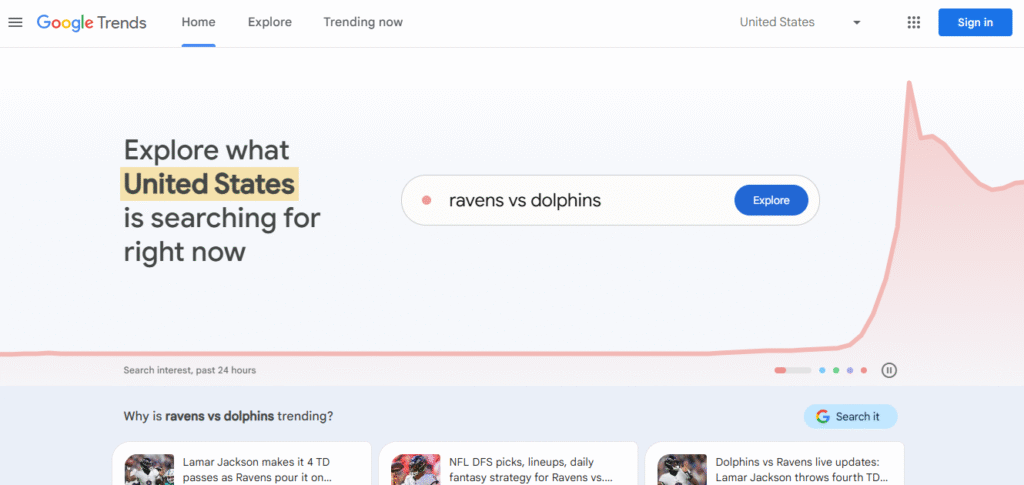
Google Trends is a free tool that offers B2B companies the ability to review search trends and analyze data within specific topics, industries, and keywords.
It allows companies to assess how the popularity of search terms has varied over a period of time, enhancing market research.
Key Features:
- Illustrates how search volume changes over time.
- Analyzes several keywords to check which ones attract more interest.
- Offers information about regional disparities, and differences, and identifies trends not previously recognized.
- Merges with Google Analytics to offer an advanced examination of web traffic.
Best For:
Google Trends provides powerful B2B functionality focused on market demand monitoring over time.
It is especially useful to identify long-term trends, emerging topics, and demand seasonality.
Conclusion
B2B market research is vital for any business that attempts to remain relevant to a changing and competitive market.
Businesses equipped with proper tools can obtain actionable insights which aids their decision-making concerning product-oriented marketing, and customer-related strategies.
The importance of tools discussed, SurveyMonkey, Qualtrics, Statista, SEMrush, BuzzSumo, LinkedIn Insights, and Google Trends, can’t be overstated.
Each B2B company can adapt their features and capabilities to their business.
The competitive edge for business is an outcome of the effective use of these tools.
Customer insights, market trends, and competitor analysis become easily accessible and actionable.
FAQs
B2B market research tools assist in recognizing new opportunities, comprehending customer requirements, assessing competitors, and leveraging data for strategic planning.
B2B tools revolve around discerning business requirements, situational industry reviews, and competitive strategies, while B2C tools concern analysis and preferences of final users, consumers, and buyers in the market.
Look for in-depth insights, real-time reports, strong analytical tools, and ease of use. Customization and integration with tools you already use will be a plus.
The market research tools’ price range is also broad. B2B research tools are control priced from $50 to hundreds of dollars a month. Some research tools are free to use, but you will have to deal with feature limitations.
Competitor analysis is key focus of some tools, for example, SEMrush and BuzzSumo, and offer insight into analysis of digital competitor strategies, content performance evaluation, and market positioning.