

The rapid evolution of AI has disrupted many sectors. Be it in healthcare, finance, manufacturing or retail, AI is less of a sci-fi trope and more of an every day fact. As AI becomes increasingly influential, the supervision of AI systems is crucial for them in working correctly and safely as well as being ethical. Best Tools for Monitoring AI Overviews brings observability solutions are essential for monitoring the performance, security, and behavior of AI models to guarantee a fully transparent system deployment that avoids hazards.
In this ultimate guide, we’re going to take an in-depth look at monitoring AI systems – What the best tools are, what they do, and how they provide a telescope for businesses and organizations implementing AI to maintain visibility over their implementations. Both general monitoring solutions and AI-specific tools, and their pros and cons will be covered. This post aims to give practical advice that information professionals can use to select the best monitoring tools for their AI deployment.
Best Tools For Monitoring AI Overviews
TensorFlow Extended (TFX)
TensorFlow Extended (TFX) is an end-to-end platform for deploying production machine learning pipelines.
It enables to do end-to-end AI model building in scale, maintain AI models and monitor everything.
TFX was developed by Google primarily with TensorFlow users in mind but it can be used alongside other frameworks.
Key Features:
- Pipeline Automation: TFX provides pipeline automation for an AI model deployment, to monitor and management throughout the complete life-cycle.
- Data Validation: Verifies that the data provided to the model is accurate and consistent, this is very important as incorrect or inconsistent data will result in biased predictions or wrong predictions.
- Model Validation: checks model validity prior to deployment for model efficacy.
- Performance Monitoring: Monitors the real time performance of production models and alerts the users if there is any slacking in performance or accuracy.
Advantages:
- Seameless integration with TensorFlow which makes it a great piece of the stack if you are already using TensorFlow.
- Scalable, it scales to a wide range of ML workflows.
- Automates the various tasks associated with model management, thereby reducing human error and saving time.
• Can be more difficult out of box than keras, you’ll need a strong foundation with TensorFlow session stuff.
Disadvantages:
- Not suitable for non-TensorFlow models or small startup companies.
Best For:
Businesses and developers that have employed TensorFlow to deploy AI models.
MLflow
MLflow is an open source platform for managing the end-to-end machine learning lifecycle.
It offers tools for experiment tracking, code packaging and model deployment.
Key Features:
- Experiment tracking: Logs all parameters, metrics and the outputs of ML experiments, enabling developers to track model performance.
- Model Management: MLflow also includes tools to version, track, and manage models.
- Deployment: The tool can be deployed in various ways from cloud platforms, to Kubernetes, and Docker.
- Model Monitoring: Monitors models (inference and training both) continuously in production making sure that they are working well and not falling down.
Advantages:
- Framework Agnostic: It can be used with any ML tool other than TensorFlow.
- Intuitive user interface for tracking experiments and managing models.
- Works with top cloud platforms including AWS, Google Cloud and Microsoft Azure.
Disadvantages:
- MLflow is general-purpose, so it might not be as specialized or full-featured as more domain-specific tools like TFX for TensorFlow users.
- It might be complicated to setup in some scenarios if integrating within and existing solution.
Best For:
Companies seeking a complete AI monitoring solution that integrates with a wide range of machine learning frameworks.
Weights & Biases (W&B)
W&B is a popular Artificial Intelligence monitoring tool that helps you track, visualize, and optimize your machine learning models.
Especially for teams that are working on big ML projects, as it comes with strong tracking and collaboration features.
Key Features:
- Experiment Tracking: Logs and visualizes important metrics, parameters and outputs of experiments automatically.
- Sharing results and comparing models – Through sharing of experiments and results including reports, dashboards, callbacks or jupyter notebooks.
- Hyperparameter Optimization: Enable tuning model by keeping track and hunting hyperparameters.
- Real-time monitoring: Provides real-time model tracking that enables teams to track models in production.
Advantages:
- User friendly interface enabling rapid experimentation tracking and visualization.
- Excellent for team work, sharing and communication.
- Monitoring in real time makes sure that models behave as they should once they’re deployed.
Disadvantages:
- Might be overkill for small projects or solo developers.
- Limited features in the free version, and paid plans are expensive for big teams.
Best For:
Teams and researchers who want to track, collaborate on, and optimize machine learning experiments at scale.
Seldon
Seldon is a powerful yet simple open source platform to manage the complete machine learning lifecycle.
It offers model validation and real time tracking capabilities from end-to-end.
Key Features:
- Model Deployment: Can be deployed on different ML libraries and environment.
- Performance Monitoring: The performance of models is monitored in near real-time, identifying any degradation or drift.
- Explainability: Provides explainable AI model capabilities to help the AI system operate transparently and ethically.
- Metrics tracking- A per model performance metrics like prediction as well as latency are logged.
Advantages:
- Extremely flexible system, your information flow can be seamlessly integrated to yours.
- High concern for model interpretability and transparency.
- Elastic: operates on AI ranging from small scale to large scale.
Disadvantages:
- Complicated setup and configuration, with a heavy technical skill set needed.
- Fewer out-of-the-box integrations than more turnkey solutions.
Best For:
Businesses and developers with a complex AI deployment, where customization is required along with detailed performance monitoring.
Fiddler
Fiddler is an AI monitoring solution that aims to offer visibility and understanding across machine learning models.
It’s built to provide real-time monitoring, model explainability and “why this prediction” insights as models are trained or evaluated.
Key Features:
- Real-Time Monitoring: Views model behaviors in real time to confirm that models function as intended.
- Explainability: Leverages explainable AI to provide insight into how a model arrived at a particular decision while promoting fairness and accountability.
- Bias Detection, monitors and mitigate bias in the model to meet ethical guidelines.
- Model Drift Detection: Realizes if models begin performing outside of their anticipated range, prompting rapid response.
Advantages:
- Such emphasis and focus on interpretability is desirable especially in domains such as healthcare, finance and legal applications.
- The above deficiencies belies robust mechanisms to mitigate bias and ensure fairness of AI systems.
- Real-time monitoring capabilities to monitor that the models are working and within expectations.
Disadvantages:
- It’s likely that pricing could exclude smaller businesses or single developers.
- Might have a bit of learning curve for people who aren’t yet familiar with model exploitability methods.
Best For:
Companies in spaces that are heavily regulated (like finance, healthcare) and require transparency and fairness of, and accountability for AI systems.
Prometheus with Grafana
Prometheus is an open-source monitoring and alarm system that is common for AI production monitoring.
When used in combination with Grafana, it is an easy-to-set up lightweight solution to store performance protocols and generate perf dashboards.
Key Features:
- Metrics Collection: Prometheus stores operational metrics including cpu usage, memory usage and request rates which allows teams to monitor system health.
- Alarm: Users can create customized alarms when metrics exceed specified limits.
- Dashboards: Grafana offers extensive visualizations for Prometheus metrics, making it simple to visualize the state and behavior of AI systems on the fly.
- Scalable: PrometheusǤ and Grafana are scalable and efficient monitoring tools for systems of any size.
Advantages:
- Extremely customizable and adjustable, with a huge community of users.
- Ideal for monitoring the health of infrastructure and systems, and for AI models.
- Free and open-source so is also a good solution for cost-conscious teams.
Disadvantages:
- There are some overheads on setup and configuration for users who aren’t familiar with Prometheus & Grafana.
- Not strictly built for AI monitoring so user might have to do some add on integrations if they are looking at AI specific monitoring.
Best For:
Tech-savvy teams seeking a modular and open-source way to monitor infrastructure as well as AI models at scale.
How These Best Tools For Monitoring AI Overviews Can Help?
Before we assess tools to help monitor AI systems, let’s take a moment to consider why monitoring these systems is important:
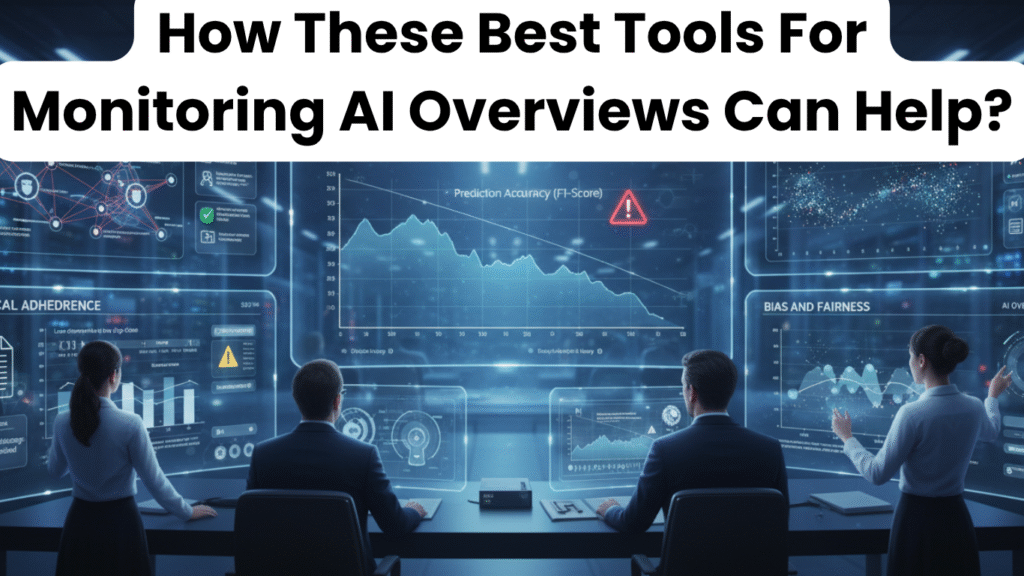
- Performance Monitoring: AI models requires monitoring for performance to be kept on track. One key advantage of performance tracking is to help catch potential anomalies, such as decay in prediction accuracy of the model over time.
- Security Oversight: Just like any technology, AI systems could be susceptible to cyber-attacks or manipulation of data. AI models need to be constantly monitored so businesses can have confidence that they are secure and delivering as they should.
- Ethical adherence: Companies are required to build machine-learning models that comply with regulations and ethical codes of propriety, especially in areas such as health care, finance or autonomous vehicles. Monitoring makes sure that AI adheres to ethical guidelines and works in a fair, transparent, accountable way.
- Bias and Fairness: By accident, AI can learn implicit biases that could result in unethical results. Observation for bias helps to identify and address it, supporting the fairness of AI-empowered decisions.
- Model Drift: As AI models age, they can eventually be affected by something called “model drift,” where their accuracy diminishes because they’re no longer matched with the real-world situations on which they were trained. Monitoring helps detect drift early.
Conclusion
AI monitoring solution landscape is quite varied, the best choice for you will depend on what you want to achieve, the size of your team and the scale of your AI operations. Whether you want an end-to-end solution like MLflow or TF Extended, dedicated tools for a single task, as Fiddler does for explainability and fairness, there’s a tool to assist you in guaranteeing that your AI models continue running smoothly, securely and ethically.
- Before selecting a monitoring tool, however, the following should be taken into consideration:
- Native compatibility with your current tech stack.
- A matter of ease and immediate integration to the workflow you have.
- Scalability to accommodate future growth.
- Particular requirements such as model interpretability, performance monitoring or bias discovery.
In an AI-powered world, the right monitoring tools are key to running maintenance efficiently and keeping trust, security and ethics in check.
Click here to read my contents on SaaS products.
FAQs
AI Sentinel is essential to make sure that AI systems are doing what’s expected, staying secure and ethical and not drifting or showing bias in the model. Ongoing checks mitigate risks for AI systems and make sure they produce accurate and fair outcomes.
It depends on what you need as a tool. TensorFlow Extended is perfect for TensorFlow users and MLflow has framework-agnostic functionality. Weights & Biases is great for collaboration and experiment tracking, while Fiddler takes on the problems of model explainability and fairness.
Yes, a lot of AI monitoring tools like Fiddler and Seldon come with capability to identify bias and mitigate them to making AIs fairer and more ethical choices.
Prometheus comes to rescue by gathering system-level data (such as CPU, memory) and notifying you of anomalies. When combined with Grafana, you can do realtime perceptibility and monitoring for your AI system’s health.
Yes, there are some free or freemium tools. Both Prometheus and Grafana are open-source, as well as TensorFlow Extended. These can be good starting points for smaller teams or solodevs.
Some things to consider include compatibility with your AI frameworks, integration ease, scalability and the particular features you are looking for—such as performance monitoring, explainability or bias detection.