

In a rapidly evolving business landscape, ERP accounting software is one of the most potent options available.to the success and scalability of an enterprise.
Of all the many tools businesses have in their arsenal for simplifying bookkeeping processes.
Such software brings together all your business functions such as finance, accounting, inventory, sales and human resources into one unified platform.
This content takes a look at what this software means, its advantages, the way it works, and respective tools to get better business procedures and operations for businesses in the US.
What is ERP Accounting Software?
ERP accounting software is a specialized tool built to handle your business financial activities. Combining general ledger, accounts payable, accounts receivable, payroll, and financial reporting into a single system.
ERP systems can add the most value to a business with intricate financial operations that need to be automated and simplified.
It enables businesses to enjoy real-time access to their financial performance, track cash flow, and, in addition, manage taxes to comply with regulatory standards.
Even, It also reduces the manual error and enhances the overall operation efficiency, decision making, etc.
Top ERP Accounting Software in USA
There are lots of ERP accounting software for sale in the market nowadays.
Here are some of the top ERP solutions for US-based businesses:
NetSuite ERP
The global ERP’s Poster Boy NetSuite is the world’s leading ERP product, nothing less than a poster child for several years.
Its full-featured accounting solutions cover general ledger, accounts payable and accounts receivable management, tax compliance, expense reporting as well as payroll management.
NetSuite is cloud-native, which is perfect for multi-location business and/or remote work forces.
QuickBooks Enterprise
It is believed that over 80% of small and middle market companies are currently using QuickBooks in the USA.
QuickBooks Enterprise is advanced end of accounting tool.
It allows users to enjoy real type working and take their employees payroll task into high gear.
It is very flexible and good in reporting.
Sage Intacct
Sage Intacct is a web-based ERP suite that includes robust accounting features.
Strong with general ledger, accounts payable/receivable and financial reporting.
Sage Intacct is a good fit for the large small to mid-sized business and has the ability to grow with.
Microsoft Dynamics 365
Microsoft Dynamics 365 is an on-premises Enterprise resource planning tool for businesses.
It integrates financial management, sales, services and operations in to a single system.
It provides full accounting solutions, such as financial reporting, budgeting, and forecasting.
Businesses that already utilize other Microsoft products may want to consider Microsoft Dynamics 365.
SAP S/4HANA
SAP S/4HANA is a business level ERP system with extensive financial management capabilities.
Examples like real-time finance reporting, asset and treasury management.
It’s meant for big, complex businesses with global financial operations.
Key Features of ERP Accounting Software
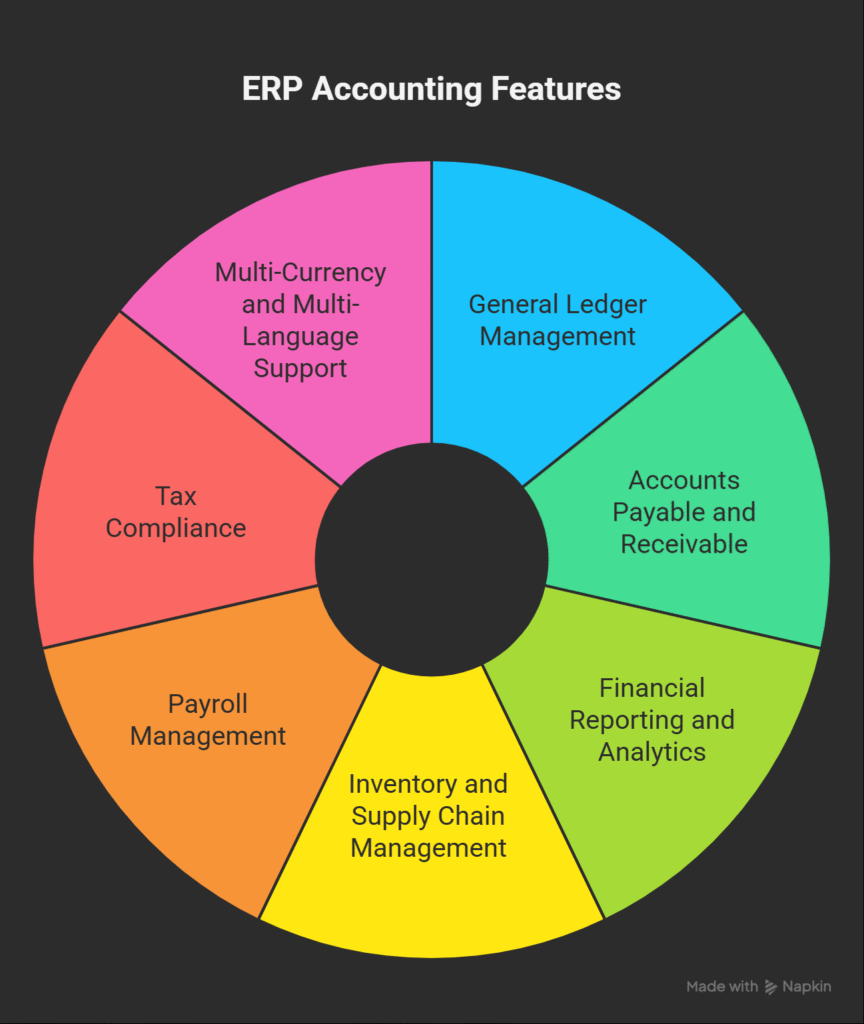
ERP accounting software offers a variety of functionality to assist businesses in managing their finances. Some of the main features are mentioned below:
General Ledger Management
General ledger is a core part of any accounting system. This software offers a single centralized general ledger.
It connects all financial data points and enables businesses to effectively manage and track their entire accounting activities.
It allows all financial transactions to be tracked. It enable businesses to produce accurate financial statements, balance sheets and profit and loss statements.
Accounts Payable and Receivable
Keeping a close eye on accounts payables (AP) and accounts receivables(AR) is essential for getting that cashflow healthy.
All these functions are automated by ERP manage their vendor payments, create a list of outstanding invoices and track payments.
Additionally, businesses use it to create reports that can be assessed for outstanding payables and receivables.
Financial Reporting and Analytics
The ability to create comprehensive financial reports is one of the most important benefits of ERP accounting software.
Such reports offer valuable insights on the profitability, cash-flow and financial health of the company.
By using advanced analytics, it can also help a business track its financial performance over time, better forecast future financial trends, and base better future predictions.
Inventory and Supply Chain Management
Another crucial parameter of ERP accounting software is inventory management.
It is especially useful for businesses dealing with tangible products to track their inventory levels and ensure they are stocked properly.
They can automate stock replenishing, track goods, and even predict what stock you need in the future according to past sales results.
Payroll Management
Payroll can be a tedious, prone-to-error process for businesses with a high borrower turnover.
ERP accounting software can automate payroll processing, including calculating salaries, withholding taxes, generating pay slips, and ensuring compliance with local and federal labor laws.
Tax Compliance
One of the most difficult parts of business finance is tax compliance.
ERP accounting software keeps the business compliance with federal, state and local tax regulations.
Multi-Currency and Multi-Language Support
If you are a business with an international customer base, these features are critical.
Many ERP software can adapt to various currencies and languages, streamlining transactions for businesses in other countries.
This comes very handy when it comes to companies from USA with multiple operations over the globe.
It is capable of computing taxes, generating tax-related documents, and filing taxes online, which can lower the risk of penalties and mistakes in tax filings.
Benefits of ERP Accounting Software
There are numerous benefits available for an ERP accounting software implementation, most especially in the USA. These benefits include:
- Improved Efficiency: ERP accounting software automates manual accounting tasks, which helps in reducing the time taken to complete routine accounting tasks.
Examples can be as data entry, invoice processing, and payroll management.
This results in enhanced operational efficacy and frees employees to engage in more strategic pursuits. - Better Financial Management: Having access to data as it happens enables companies to help profitability by making sound decisions.
They help monitor cash flow and cut costs to give businesses an overarching view of the company finances.
It makes easier for them to optimize their financial strategies. - Enhanced Collaboration: ERP accounting software system assembles virtually all departments and roles within a business together.
It enhances agreement and coordination.
For instance, the sales, finance, and inventory teams all use the same data which helps to streamline activities and compliance with business objectives when making financial decisions. - Reduced Risk of Errors: Human error is inherent in manual accounting processes.
By automating calculations, reconciliations, and data entry processes, This software minimizes the room for errors.
As a result, we get more accurate financial reports and fewer compliance violations. - Better Regulatory Compliance: These bookkeeping software assists businesses in last managing regulatory concerns throughout local, state, and federation laws and regulations with more efficiency.
Automating tax calculations, financial reports, and ensuring compliance with accounting standards minimizes the risk of legal problems or penalties to the business for not meeting the standards. - Scalability: Financial operations become deeper, wider, and more complicated as businesses (and their departments/teams) scale up.
Whether a company expands into new markets or increases its product and service offerings, ERP systems can manage added complexity without a complete overhaul. - Cost Savings: Although there is an initial investment needed to implement ERP software, it can benefit your accounting department and the overall business with substantial savings over time.
One Way Accounting software automates several time-consuming accounting tasks, which ultimately reduces labor needs, and improves financial management, which allows businesses to optimize their cash flow and minimize operational expenses.
How ERP Accounting Software Works?
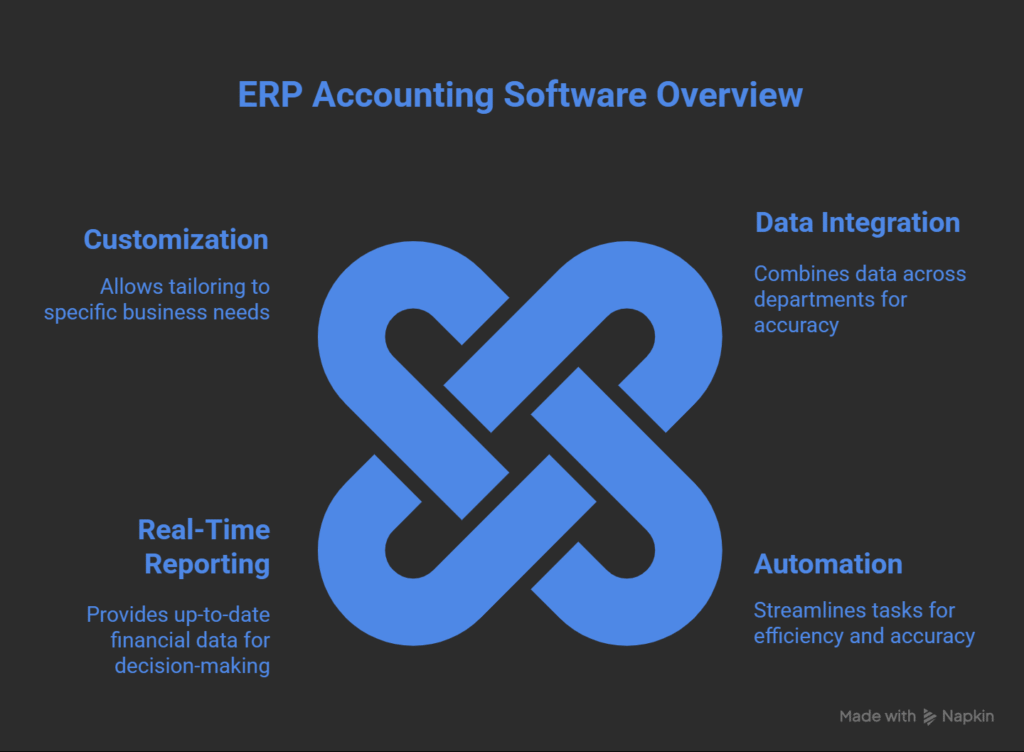
The foundation behind some of the functions performed by ERP accounting software is its power to integrate business processes into one system. Here’s how it works:
Data Integration
ERP software combines data across various departments and business areas.
The software can link sales data from the sales department to financial data in the accounting system, which ensures accurate record-keeping of all financial transactions.
Automation
It lightens the load for accounting personnel and ensures tasks are done in a timely and error-free manner.
Real-Time Reporting
This software brings access to real-time financial data, necessary for businesses to make informed decisions.
By maintaining the most recent financial reporting information, corporates can track their finances along with their performance.
they also manage any ongoing adjustments in line in the path of achieving their intended targets.
Customization
The ERP software comes along with a high level of customization that helps any business to customize it exactly as per their business needs.
To take an example, a business could have custom reports, customize workflow settings and many others to synchronize it with their accounting process.
Conclusion
ERP accounting software is critical because companies need to increase the efficiency of their financial processes.
Automating invoicing, payroll, tax calculations, and reporting minimizes manual errors, increases cash flow management and generates compliance with regulations thereby making this a benefit of finance automation to the organization as well.
ERP systems are designed to meet the needs of every organization and there are many ERP options available in the USA, covering small, medium or large businesses.
ERP software implementation is done not just randomly, it should have proper accounts of the business needs, goals, and budget.
But businesses of the size should know that the returns can be lovely in the long term; better financial transparency, more informed decision making, operational efficiency, the list goes on.
Click here to read my contents on Business tools.
FAQs
ERP accounting software is an integrated system that combines multiple business operations such as financial management, accounting, payroll, and reporting into one collective whole.
they help businesses automate and streamline their financial tasks, and make informed decisions.
ERP accounting software can help businesses boost efficiency through bookkeeping automation, cohesive financial visibility, regulatory compliance, and seamless cross-department collaboration.
Yes, most of the ERP accounting software comes with customization options where businesses can customize the system as per their business need.
For example creating a custom report/ changing in the workflow.
Some of the best ERP accounting software options for small businesses include QuickBooks Enterprise, Sage Intacct, and Microsoft Dynamics 365, all of which offer scalable features and robust bookkeeping tools.
The ERP accounting software takes care of the local, state, and federal tax regulations right by automating the tax calculations, tax reporting, and tax filing through the electronic mode.